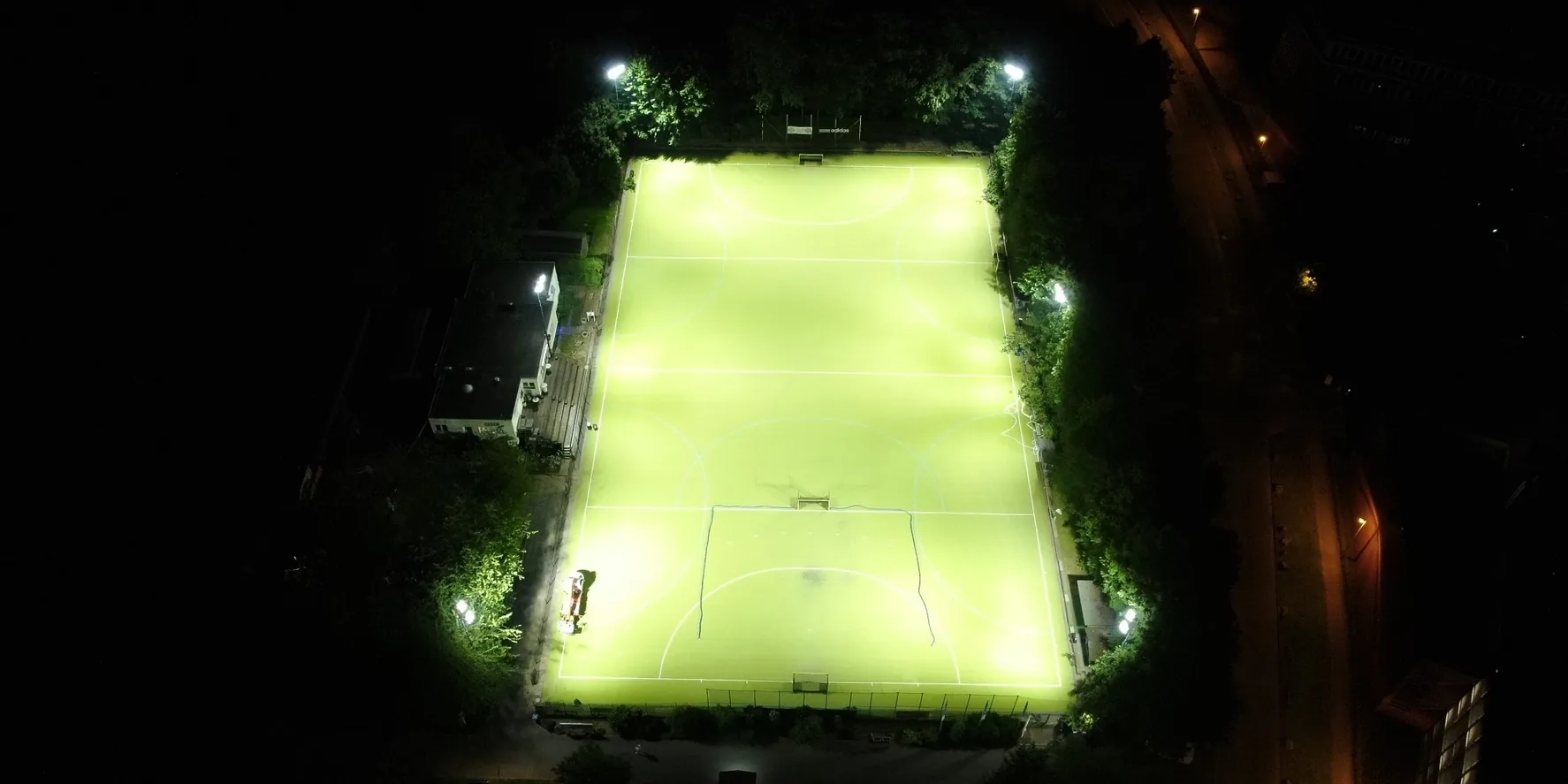
What is floodlighting?
Floodlighting lights large areas from a few high points. The floodlights sit on poles at the edge of the area and are aimed at it. Typical applications are sports pitches, industrial sites, storage and handling areas, ports and large car parks.
How does floodlighting differ from ordinary outdoor lighting?
A street or yard luminaire spreads its light broadly around its own position. A floodlight throws it in a directed beam onto a distant area. That is why floodlighting systems sit higher, are tilted and work with narrower optics – and why the result depends more on the aiming than on the power output.
Which optic suits which area?
Series 12 is available with 20° and 40°, and both optics can be mixed within a single floodlight. As a rule of thumb: the further a floodlight is from the part of the area it is meant to light, the narrower the optic. Which mixture fits in a given case comes out of the lighting calculation.
How many poles and floodlights does an area need?
There is no general answer. It depends on the size and shape of the area, on the required illuminance and uniformity, on the pole height, and on where poles can be placed at all. We work this out in advance with the photometric data of the luminaires, before any quantities appear in a quotation.
Can floodlighting be dimmed or switched in stages?
Yes. Series 12 has a 0–10 V interface. This allows different levels for training, match play and competition, as well as a reduction in the later hours.
Does floodlighting withstand frost, heat and hail?
Series 12 is rated IP66 and IK10 and specified for a range from −40 °C to +50 °C. The housing is die-cast aluminium.