By app, not on foot.
The luminaires test themselves: an automatic function test every month and the full duration once a year, to EN 50172 and EN 62034. Nobody has to walk the building with a ladder and a clipboard.

Emergency escape lighting keeps escape routes visible and usable when nothing else is lit. We develop and manufacture it in Germany – with the battery in the housing, 1.5 or 3 hours of emergency operation and automatic testing through the app instead of a monthly walk-round.
The luminaires test themselves: an automatic function test every month and the full duration once a year, to EN 50172 and EN 62034. Nobody has to walk the building with a ladder and a clipboard.
Every test is recorded as a fixed log in the app and can be exported. That meets the documentation duty without anyone keeping a test book by hand.
The walking, the hours and the appointments that used to come round every month simply go. The work shifts from walking the building to reading the log.
Every luminaire brings its own power supply – for either 1.5 or 3 hours of emergency operation. That removes the need for central battery systems, dedicated circuits and fire-resistant wiring. In existing buildings this is often the only route that avoids construction work.
In normal operation everything is lit. If the supply fails, only the luminaires with their own battery and the exit signs stay on – enough to find the way out.
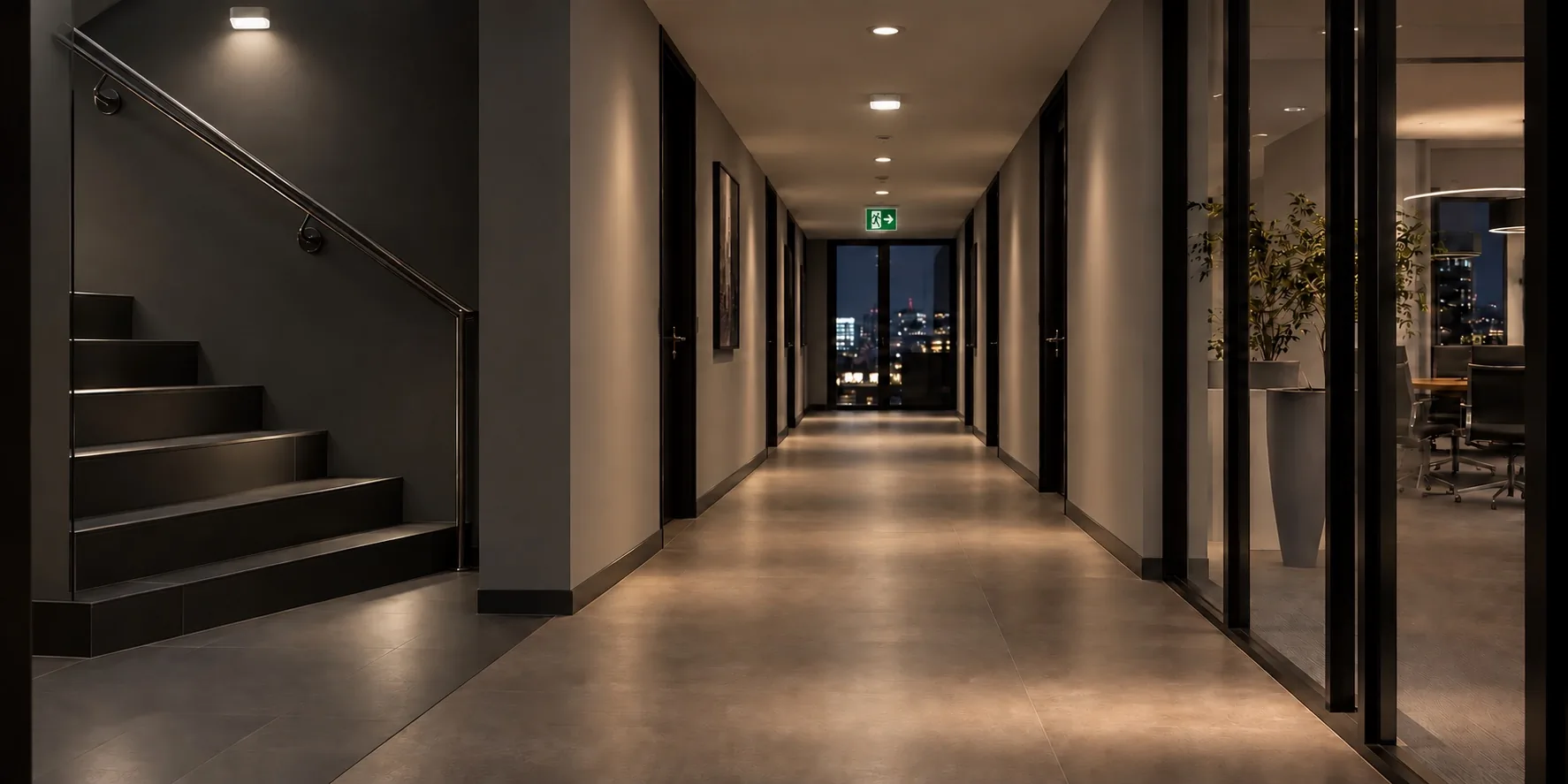
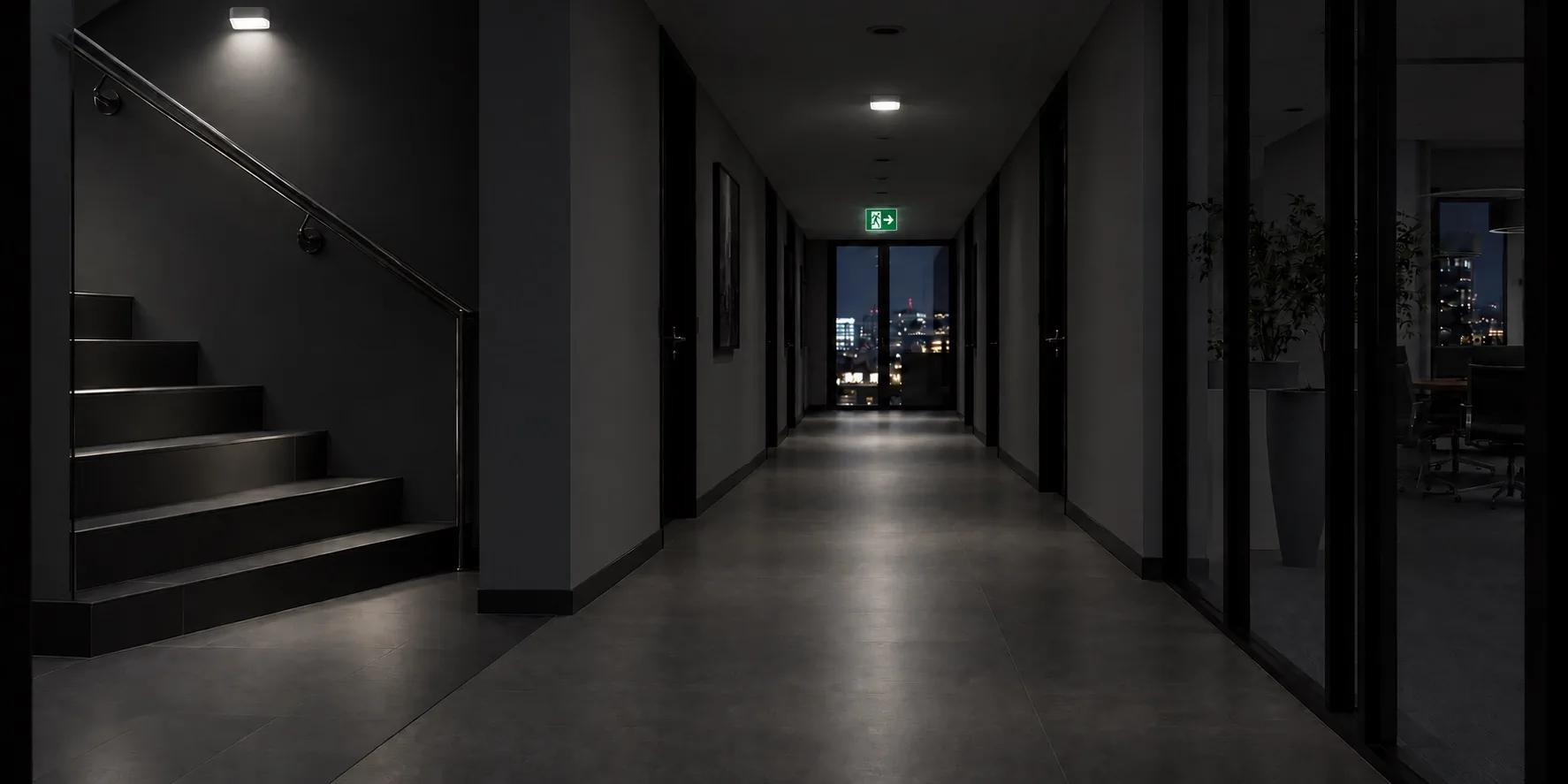 Normal operationAI-generated example scene
An illustration, not a lighting calculation. How many luminaires stay on in emergency mode, and how bright it then is, comes out of the design for your building.
The part of emergency lighting that keeps escape routes and exits safely visible and usable. It also covers exit signs, open area lighting and workplaces with a particular risk.
Light that lets work carry on during a power cut. It serves operations, not evacuation – and does not replace emergency escape lighting.
The umbrella term for both: everything that gives light when the general power supply fails.
The standard sets the minimum brightness in emergency mode. The values apply at floor level, or vertically at the equipment – and at the end of the rated duration, when the battery is nearly empty.
All values in the guideOn site visits we keep finding installations that were put in and signed off – and whose ongoing testing then quietly stopped. The effort comes round monthly, the business keeps running, the luminaires hang high up, responsibilities change. In the end the system may well work, but nobody can prove it.
That is exactly what counts when it matters: not whether emergency escape lighting was installed, but whether it was demonstrably operational . Only the documentation provides that proof – to the authorities, to insurers and, if it comes to it, in court. The same applies during inspections: a working installation without a test log is a defect.
Guide: testing emergency lightingThis is not legal advice. Which duties apply to your building is settled by the risk assessment, the building permit and, in case of doubt, a competent person.
Emergency escape lighting has to be tested regularly and every test documented. How much that adds up to in a year depends on the number of luminaires.
The luminaires test themselves: function and duration tests run automatically to EN 50172 and EN 62034. Instead of visiting every luminaire, you read the finished log in the app and export it as proof.
See Series 19Intervals to DIN EN 50172 and DIN VDE V 0108-100-1. What applies to your building always takes precedence.
Every luminaire has its own battery.
Strength: Easy to retrofit, no battery room, no fire-resistant wiring.
Watch out for: Batteries in every luminaire, many individual units to test.
One battery supplies a limited number of luminaires.
Strength: A middle way for medium-sized buildings.
Watch out for: Requirements for cabling and installation location apply.
One central system supplies every luminaire.
Strength: Maintenance in one place, central monitoring.
Watch out for: Needs a battery room and fire-resistant cabling.
Which system fits depends on the size of the building, what is already installed and the rules for your site.
We do more than supply luminaires; we see the project through: survey, lighting design to DIN EN 1838, choosing the right duration, installation and commissioning. Developed and manufactured in Germany since 2009.
See what we do Discuss your projectWhether emergency escape lighting is required follows from how the building is used, the state building code and the rules for special buildings – for workplaces also from the risk assessment under the German workplace ordinance. Typical cases are assembly buildings, retail premises, hotels, schools, hospitals, car parks and larger workplaces.
On escape routes up to 2 metres wide, DIN EN 1838 requires at least 1 lux on the centre line at floor level. At fire extinguishers, call points and first-aid posts at least 5 lux is required. Open area lighting and workplaces with a particular risk have their own values.
Under DIN EN 50172 and DIN VDE V 0108-100-1: for central systems a daily visual check of the indicators, monthly a function test of every luminaire and sign, and annually a test over the full rated duration. Every test has to be documented.
The rated duration depends on the type of building and is set out in the relevant rules. One hour or three hours are common. Which value applies to your building is settled during design.
It depends on the building. Self-contained luminaires can be retrofitted without a battery room and without fire-resistant wiring, so in existing buildings they are often the faster route. Central battery systems bring maintenance and monitoring together in one place and come into their own in large buildings.
Lighting audit, lighting design, luminaires, lighting controls and installation all come together with one person at TRiALED.
How we work