Basics: ATEX and zones
In the EU, two ATEX directives govern explosion protection: Directive 2014/34/EU covers equipment and protective systems, and therefore luminaires. Directive 1999/92/EC covers the protection of workers and is implemented in Germany through the Hazardous Substances Ordinance and the Industrial Safety Ordinance, among others.
| Zone | Explosive atmosphere | Typical equipment category |
|---|---|---|
| Zone 0 (gas) | Continuously, for long periods or frequently | 1G |
| Zone 1 (gas) | Occasionally in normal operation | 2G or 1G |
| Zone 2 (gas) | Rarely and only briefly | 3G, 2G or 1G |
| Zone 20 (dust) | Continuously, for long periods or frequently | 1D |
| Zone 21 (dust) | Occasionally in normal operation | 2D or 1D |
| Zone 22 (dust) | Rarely and only briefly | 3D, 2D or 1D |
Reading the Ex marking
An Ex luminaire carries a marking that describes what it is suitable for. A typical example for gas:
II: Equipment group for areas outside mining
2G: Equipment category 2 for gas – suitable for zones 1 and 2
Ex db eb: Types of protection, here flameproof enclosure and increased safety
IIC: explosion group – IIC covers the most easily ignited gases, for example hydrogen
T4: temperature class – maximum surface temperature 135 °C
Gb: equipment protection level suitable for zone 1
| Temperature class | Maximum surface temperature |
|---|---|
| T1 | 450 °C |
| T2 | 300 °C |
| T3 | 200 °C |
| T4 | 135 °C |
| T5 | 100 °C |
| T6 | 85 °C |
The ignition temperature of the substances present must be above the maximum surface temperature of the luminaire. For dusts, the maximum surface temperature is usually stated directly instead of a temperature class, together with the dust group IIIA, IIIB or IIIC.
Types of protection for luminaires
- Ex d – flameproof enclosure: an explosion inside is contained within the housing.
- Ex e – increased safety: design measures prevent sparks and impermissible temperatures.
- Ex i – intrinsic safety: energy is limited so that ignition is impossible, usually for signals and sensors.
- Ex nA, Ex ec: types of protection for zone 2.
- Ex t – protection by enclosure: for dust areas; dust cannot enter in ignitable quantities.
Why LED makes particular sense in hazardous areas
- Less heat: efficient LEDs generate less waste heat – which makes low temperature classes easier to achieve.
- Less maintenance: Opening an Ex luminaire is laborious and has to be done properly. A long service life reduces such interventions.
- No glass bulbs: no fragile lamps running at high temperatures.
- Instantly bright: no warm-up, no restrike time after brief voltage dips.
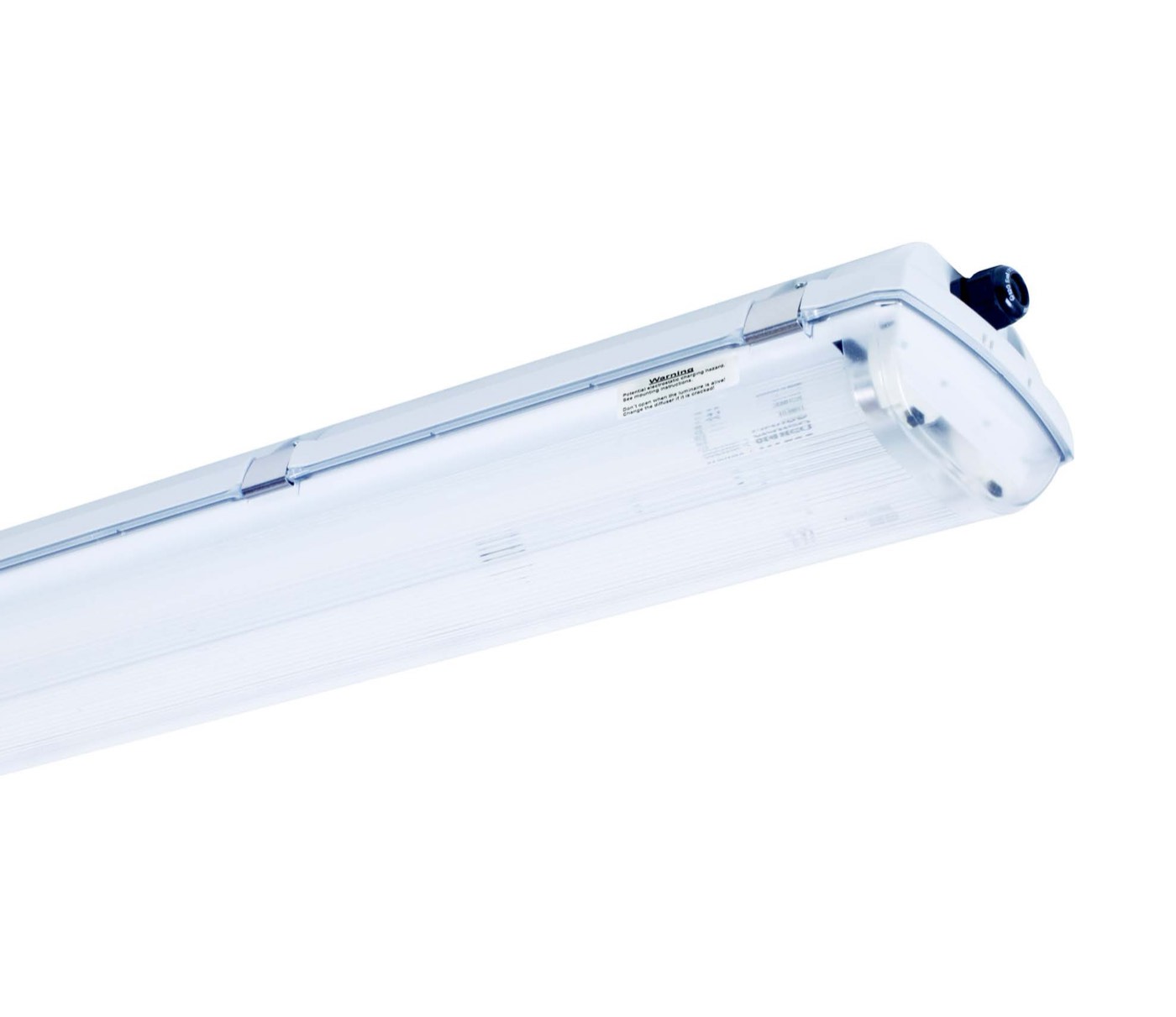
The Series 09 industrial luminaire from TRiALED is also available in Ex versions, with up to IP66 and IK10 depending on the variant. Which version suits your zone and substances is clarified on the basis of your zone classification.
Typical applications
| Area | Typical hazard |
|---|---|
| Paint and coating plants | Solvent vapours |
| Chemicals, pharmaceuticals, laboratories | Gases and vapours |
| Tank farms and filling plants | Fuel and solvent vapours |
| Mills, animal feed, food | Flour, sugar and grain dust |
| Woodworking | Wood dust |
| Biogas and sewage treatment plants | Methane |
| Battery charging areas | Hydrogen, depending on ventilation and risk assessment |
Operator duties and inspections
Electrical installations in hazardous areas have to be inspected before commissioning and at recurring intervals, depending on the requirement by a qualified person or an approved inspection body. Installation, maintenance and repairs may only be carried out by suitably qualified specialists. Plan these steps into a conversion from the outset.
ConsultationLet's talk about your project.Lighting calculation and quotation from the manufacturer.Frequently asked questions
Which luminaire do I need for zone 1?
For zone 1, equipment of category 2G or 1G with equipment protection level Gb or Ga is suitable. The explosion group and temperature class have to match the gases present.
What does T4 mean on Ex luminaires?
T4 is a temperature class: the surface of the luminaire reaches no more than 135 °C. The ignition temperature of the substances present has to be above that.
Who defines the Ex zones?
The operator, as part of the risk assessment and in the explosion protection document, often with support from specialists.
May I use a normal LED luminaire in zone 22?
No. Zone 22 also requires equipment with a suitable category and dust protection, at least category 3D.
Does TRiALED offer Ex luminaires?
The Series 09 industrial luminaire is also available in Ex versions. We clarify the right variant on the basis of your zone classification.