Colour temperature: what does kelvin mean?
Colour temperature is stated as the correlated colour temperature in kelvin (K). Low values appear warm and yellowish, high values cool and bluish.
| Colour temperature | Colour temperature | Effect | Typical use |
|---|---|---|---|
| Warm white | up to 3,300 K | Cosy, relaxing | Reception, break rooms, outdoor areas with insect protection |
| Neutral white | 3,300 to 5,300 K | Businesslike, activating | Offices, industry, logistics, schools |
| Daylight white | above 5,300 K | Cool, very clear | Inspection stations, laboratories, individual industrial areas |
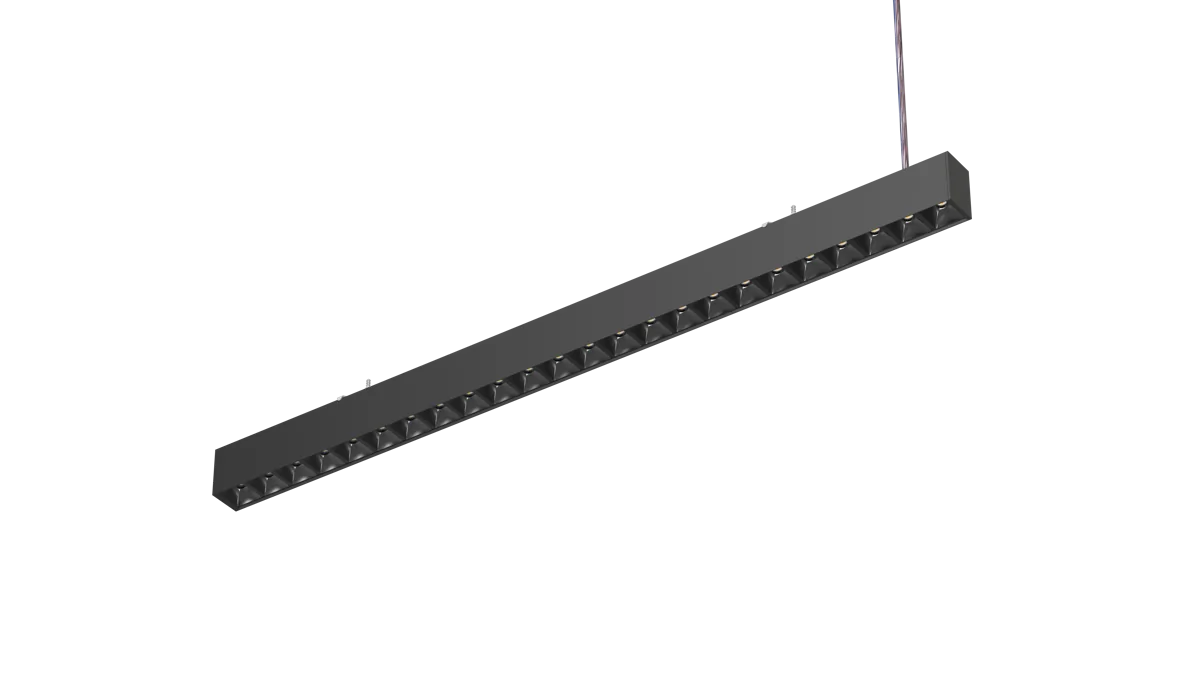
In commercial interiors 4,000 K is the most widespread. Outdoors the trend is towards 3,000 K or warmer, because warm light with a low blue content is considered more insect-friendly and less dazzling. The Series 18 Blackline for example is available in 3,000, 4,000 and 5,000 K.
Colour rendering: the Ra value (CRI)
The colour rendering index Ra, internationally also called CRI, describes how natural colours appear under a light source compared with a reference source. The maximum value is 100.
| Ra value | Rating | Typical use |
|---|---|---|
| below 60 | Moderate | Only for minor areas |
| 60 to 79 | Sufficient for simple tasks | Simple storage and ancillary areas |
| 80 to 89 | Good – the standard for workplaces | Office, industry, logistics |
| 90 and above | Very good | Colour inspection, printing, paint shops, retail, food inspection |
Which colour temperature for which area?
- Office: 4,000 K with Ra ≥ 80 as standard, warm white in meeting and break areas. More in the guide office lighting.
- Production and workshop: 4,000 K, with higher colour rendering for inspection and painting. More in the guide workshop lighting.
- Warehousing and logistics: 4,000 K, good readability of labels.
- Food: good colour rendering for visual inspection. More in the guide food industry.
- Car parks, roads, paths: 3,000 K or warmer. More in the guide car park lighting.
- Sport: neutral white with good colour rendering, especially for broadcasts.
Tunable white: light through the day
Luminaires with tunable white change their colour temperature continuously, for example from 3,000 to 6,500 K. This lets artificial light follow the course of daylight: cooler and more activating in the morning, warmer in the afternoon. The concept is often described as human-centric lighting. More in our announcement on the LED panel with tunable white.
Further quality characteristics
- Colour consistency: luminaires with the same colour temperature should also look the same. Tight tolerances prevent an uneven appearance.
- Flicker: high-quality drivers avoid visible and invisible flicker, which can be tiring.
- Glare: regardless of colour temperature, glare control determines visual comfort. More on UGR in the guide office lighting.
Frequently asked questions
Which is better: 3000 K or 4000 K?
It depends on the application. 4,000 K is standard in offices, industry and logistics. 3,000 K feels warmer and is used in reception and break areas and increasingly outdoors.
What does Ra 80 mean?
Ra 80 means good colour rendering and is the usual minimum for workplaces. For colour-critical tasks the value should be higher.
Is CRI the same as Ra?
Yes, both terms refer to the general colour rendering index. Ra is the term common in Europe, CRI the English abbreviation.
Which colour temperature is insect-friendly?
Warm white light with a low blue content, around 3,000 K or warmer, is considered more insect-friendly than cool white light.