The IP rating: two digits, two statements
The IP code (International Protection, defined in DIN EN 60529) consists of two digits. The higher the digit, the higher the protection.
| First digit | Protection against solid objects |
|---|---|
| 2 | Solid objects from 12.5 mm (e.g. fingers) |
| 4 | Solid objects from 1 mm (e.g. wires) |
| 5 | Dust-protected |
| 6 | Dust-tight |
| Second digit | Protection against water |
|---|---|
| 0 | No protection |
| 4 | Splashing water from all directions |
| 5 | Water jets from any angle |
| 6 | Powerful water jets |
| 7 | Temporary immersion |
| 8 | Continuous immersion |
| 9K | High-pressure and steam jet cleaning (IPX9K to ISO 20653) |
Which rating for which location?
| Location | Commonly used rating |
|---|---|
| Dry offices and retail spaces | IP20 |
| Covered outdoor areas, ancillary rooms | IP44 and above |
| Dusty production halls | IP54 to IP65 |
| Damp rooms, wash bays, car parks | IP65 and above |
| Outdoor areas, floodlighting, street lighting | IP65 to IP66 |
| Food areas with wet cleaning | IP65 to IP69K, depending on the cleaning method |
The table gives you a starting point. Which rating is actually needed depends on soiling, cleaning, temperature changes and, where applicable, industry-specific requirements.
- Series 07 high bay: up to IP65, depending on the version
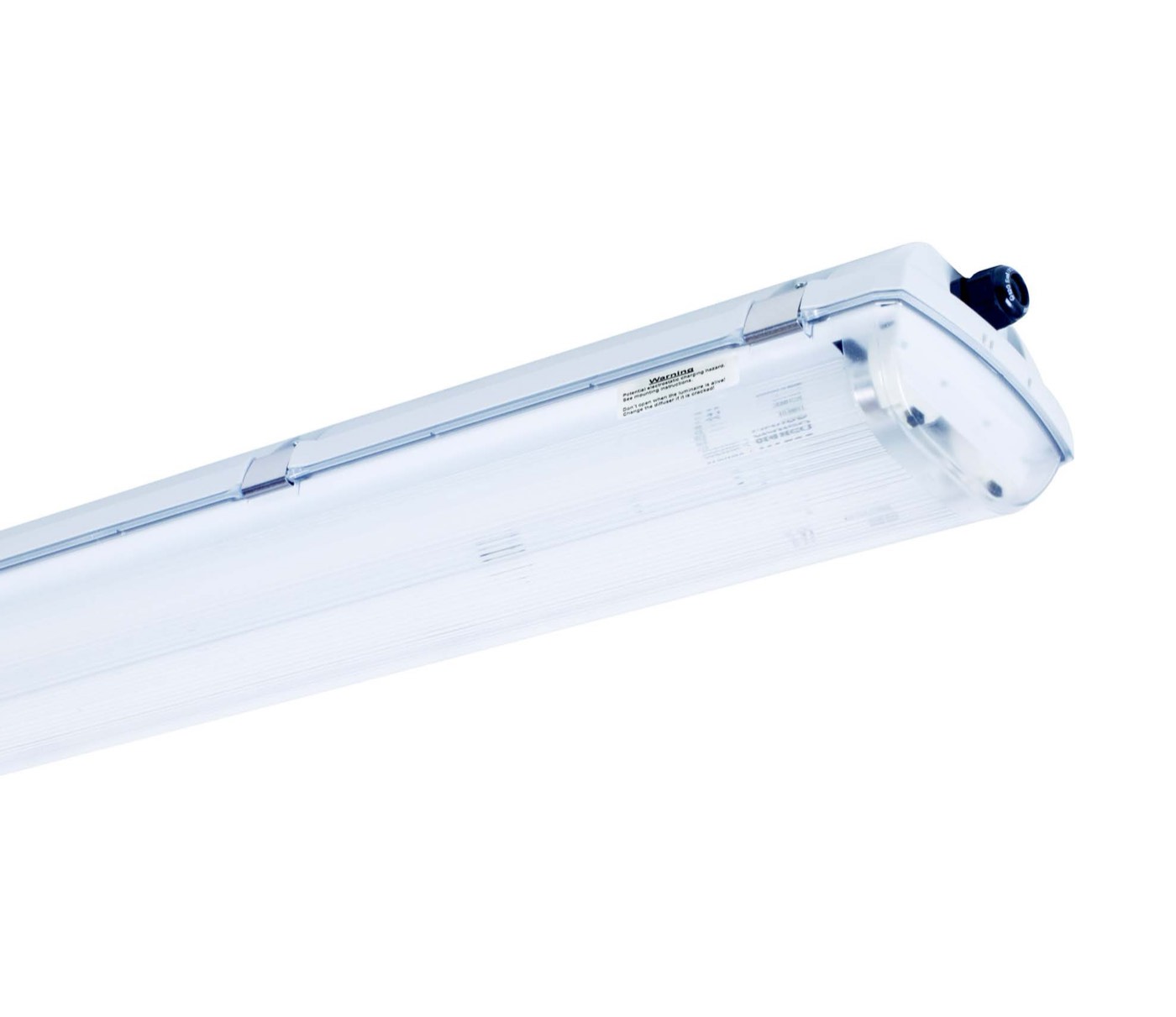
- Series 09 industrial luminaire: up to IP66, also as an Ex version
- Series 12 floodlight and Series 16 street light: IP66
- Series 98 weatherproof luminaire: complete fittings for commerce and industry
IK code: protection against impact
The IK code (DIN EN 62262) states the impact energy a housing can withstand. That matters in sports halls, car parks, warehouses with forklift traffic and in public spaces.
| IK code | Impact energy |
|---|---|
| IK06 | 1 joule |
| IK07 | 2 joules |
| IK08 | 5 joules |
| IK09 | 10 joules |
| IK10 | 20 joules |
The Series 16 street light achieves IK08, the Series 12 floodlight IK10 and the Series 09 industrial luminaire up to IK10.
Protection rating, protection class, Ex: what is what?
- Protection rating (IP): protection against the ingress of solid objects and water.
- Protection class (I, II, III): protection against electric shock – for example via an earth conductor (I) or double insulation (II).
- Ex protection: luminaires for potentially explosive areas, for example with flammable gases or dusts. Special standards and zone classifications apply here.
Temperature and condensation
Besides dust and water, the permitted temperature range matters. In a deep-freeze warehouse or outdoors in winter the luminaire has to start reliably; in hot halls the LEDs and driver must not overheat. The Series 10 linear high bay and the Series 12 floodlight are designed for down to −40 °C, for example. Temperature changes can cause condensation – another reason why the right protection rating matters.
Product finderWhich luminaire suits your project?A few questions lead to a recommendation.Frequently asked questions
What does IP65 mean?
The 6 stands for dust-tight, the 5 for protection against water jets from any angle. IP65 is typical for outdoor areas, damp rooms and dusty halls.
What is the difference between IP65 and IP66?
Both are dust-tight. IP66 additionally protects against powerful water jets, IP65 against normal water jets.
Which rating do I need outdoors?
Outdoor luminaires usually use IP65 or IP66. Surge protection, temperature range and, where applicable, impact resistance are added to that.
What does IK10 mean?
IK10 is the highest level of the IK code. The housing withstands an impact with 20 joules of energy.
Is IP the same as protection class?
No. The IP rating describes protection against dust and water, the protection class protection against electric shock.