What luminaires in the food industry have to achieve
- Foreign body protection: broken glass or brittle plastic splinters must never reach the product. Food standards such as IFS Food or BRCGS therefore require consistent glass and hard plastic management.
- Cleaning: high-pressure, foam and steam cleaning as well as aggressive detergents attack unsuitable housings and seals.
- Hygienic design: few edges and gaps, smooth surfaces, no exposed screw heads or cooling fins where dirt can collect.
- Temperature: From the baking line to the deep-freeze warehouse, ambient temperatures cover a wide range.
Protection rating and materials
| Area | Common requirement |
|---|---|
| Dry storage, packaging | IP54 to IP65 |
| Production with wet cleaning | IP65 to IP66 |
| High-pressure and steam jet cleaning | IP69K |
| Chilled and frozen rooms | High protection rating, resistance to condensation, suitability for low temperatures |
Covers made of polycarbonate or PMMA instead of glass, durable seals and stainless steel catches are common in wet areas. Which materials are compatible with your cleaning agents should be checked in advance. You can read more about the codes in the guide IP ratings and IK impact ratings.
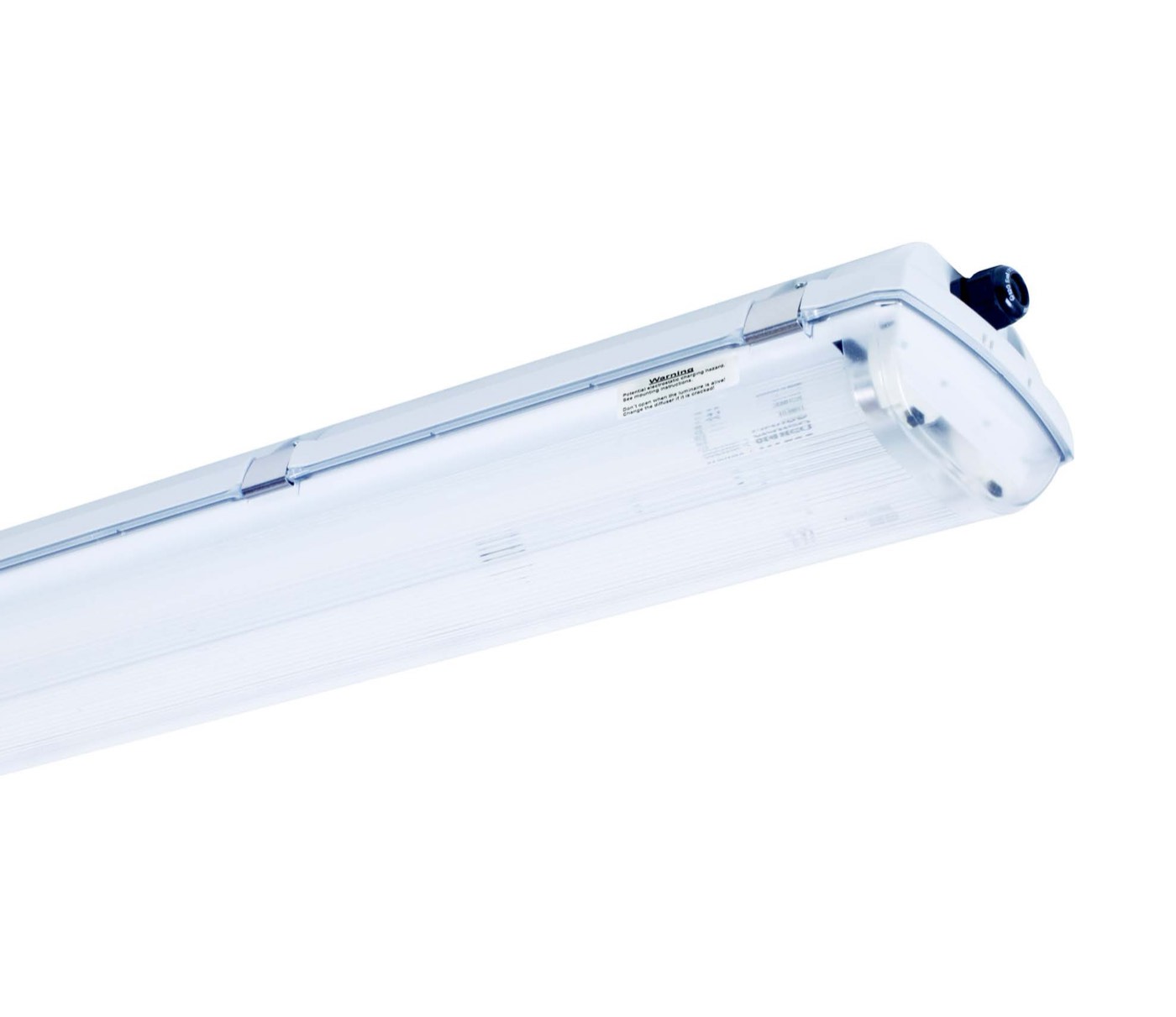
Rugged luminaires for these areas are the Series 09 industrial luminaire up to IP66 and IK10 with versions for hygiene areas, and the Series 98 weatherproof luminaire.
How bright does it have to be?
For activities in the food and beverage industry, DIN EN 12464-1 states values between roughly 200 and 500 lx, and higher values for inspection and sorting work. Typical guide values:
| Activity | Typical maintained value |
|---|---|
| General work areas in production | 300 lx |
| Cutting, sorting, preparing | 300 lx |
| Inspection, decorating, colour matching | 500 lx |
| Storage, cold rooms | 100 to 200 lx |
| Dispatch, packaging | 300 lx |
For visual inspection, for example of meat, fruit or baked goods, colour rendering is decisive. At least Ra 80 is standard; for demanding inspection tasks Ra 90 can make sense. More on this in the guide colour temperature and colour rendering.
Cold rooms and deep-freeze warehouses
LEDs work efficiently in the cold. On top of that, every watt of lighting becomes heat in a chilled room that the refrigeration system has to remove again. Efficient LED luminaires and sensors therefore reduce not only the lighting's energy consumption but also the load on the cooling. More in the guide cold store lighting.
From practice: Carl Kühne in Straelen
At the food manufacturer Carl Kühne in Straelen production and logistics areas were converted to LED. The result: 74 % less lighting energy.
ConsultationLet's talk about your project.Lighting calculation and quotation from the manufacturer.Frequently asked questions
Which luminaires are permitted in the food industry?
Shatterproof luminaires without glass should be used above open products. Food standards such as IFS Food and BRCGS require glass and hard plastic management. Depending on the area, high protection ratings and cleaning-resistant materials are added.
Which protection rating do I need for wet cleaning?
For wet cleaning with a water jet, IP65 or IP66 are usual; for high-pressure and steam jet cleaning, IP69K.
How brightly does food production have to be lit?
Typical values are 300 lx for general production areas and 500 lx for inspection and sorting work under DIN EN 12464-1.
Does LED save twice over in a cold room?
Yes. Less lighting power means less heat in the cold room for the refrigeration system to remove.