What does § 56 GModG require?
§ 56 GModG governs building automation and control. Two paragraphs are decisive for lighting:
| Control | Contents | Deadline |
|---|---|---|
| § 56 para. 1 | Building automation and control system in non-residential buildings with a rated output of more than 70 kW | 31.12.2029 |
| § 56 para. 6 | In addition, automatic lighting control. It is to be appropriately zoned and have occupancy detection. | 31.12.2029 |
The duty only lapses if fitting the system is technically impossible or economically unreasonable. The owner must be able to justify this for the building.
GModG check: is your building affected?
Three questions are enough for a first assessment. The check does not replace a review by an energy consultant or building services engineer.
Is your building affected?
§ 56 only applies to non-residential buildings. Other rules of the GModG apply to residential buildings.
As long as the rated output of heating, air conditioning and ventilation does not exceed 70 kW, § 56 does not apply. Lighting control often pays off anyway – through lower electricity consumption alone.
What counts is the maximum output in continuous operation on the rating plate. Generators controlled as one system are added together. Your energy consultant or building services engineer can confirm this.
Discuss lighting under the GModGThe duty lapses if fitting the system is technically impossible or economically unreasonable. Have the justification confirmed by a specialist and keep it on file.
By 31 December 2029 you need a building automation system and automatic lighting control – appropriately zoned and with occupancy detection. For the lighting, we take care of design, luminaires, sensors and installation.
Discuss lighting under the GModGInitial guidance on § 56 GModG, not legal advice. As of October 2026.
EPBD and GModG: what applies in Germany?
The EU buildings directive EPBD (Directive (EU) 2024/1275) is the framework for all member states. It does not oblige owners directly; it obliges the states to transpose its requirements into national law. In Germany this is done through the GModG – and that is what counts for owners.
| EPBD (EU framework) | GModG (Germany) | |
|---|---|---|
| Who is obliged? | the member states | the building owners |
| Lighting control, large buildings | over 290 kW by 31 Dec 2027 | no separate stage – a single 70 kW threshold applies |
| Lighting controls | over 70 kW by 31 Dec 2029 | over 70 kW by 31 Dec 2029 |
| Building automation | over 290 kW by end of 2024, over 70 kW by end of 2029 | over 70 kW by 31 Dec 2029; the previous 290 kW threshold under § 71a GEG no longer applies |
For buildings in Germany, then: more than 70 kW rated output, deadline 31 December 2029 – for building automation and lighting control alike. The European background is explained in the guide EU buildings directive and lighting.
What lighting control under § 56 should be able to do
- Automatic switching: The light goes off when nobody is there – without anyone having to remember.
- Zones: Areas with different uses, such as aisles, workstations and storage zones, are controlled separately.
- Occupancy detection: presence or motion detectors register whether an area is in use.
- Data for building automation: The system under paragraph 1 is to monitor consumption and provide data via an open interface. Lighting control that supplies its data fits into this framework.
§ 56 does not prescribe daylight control or dimming. But they often deliver a large share of the savings. And if you want to use funding, note that under § 89 GModG, as a rule only measures that go beyond the legal requirements are funded.
How presence detectors and control types work is explained in the guides Presence detectors and light control and DALI or 1–10 V.
How we implement lighting control
- Lighting audit: We record luminaires, drivers, usage zones and operating hours digitally – with our own app.
- Design: We calculate the lighting with DIALux to EN 12464-1 and plan the sensors with our app Sensora: sensor positions, detection areas and usage are simulated before installation.
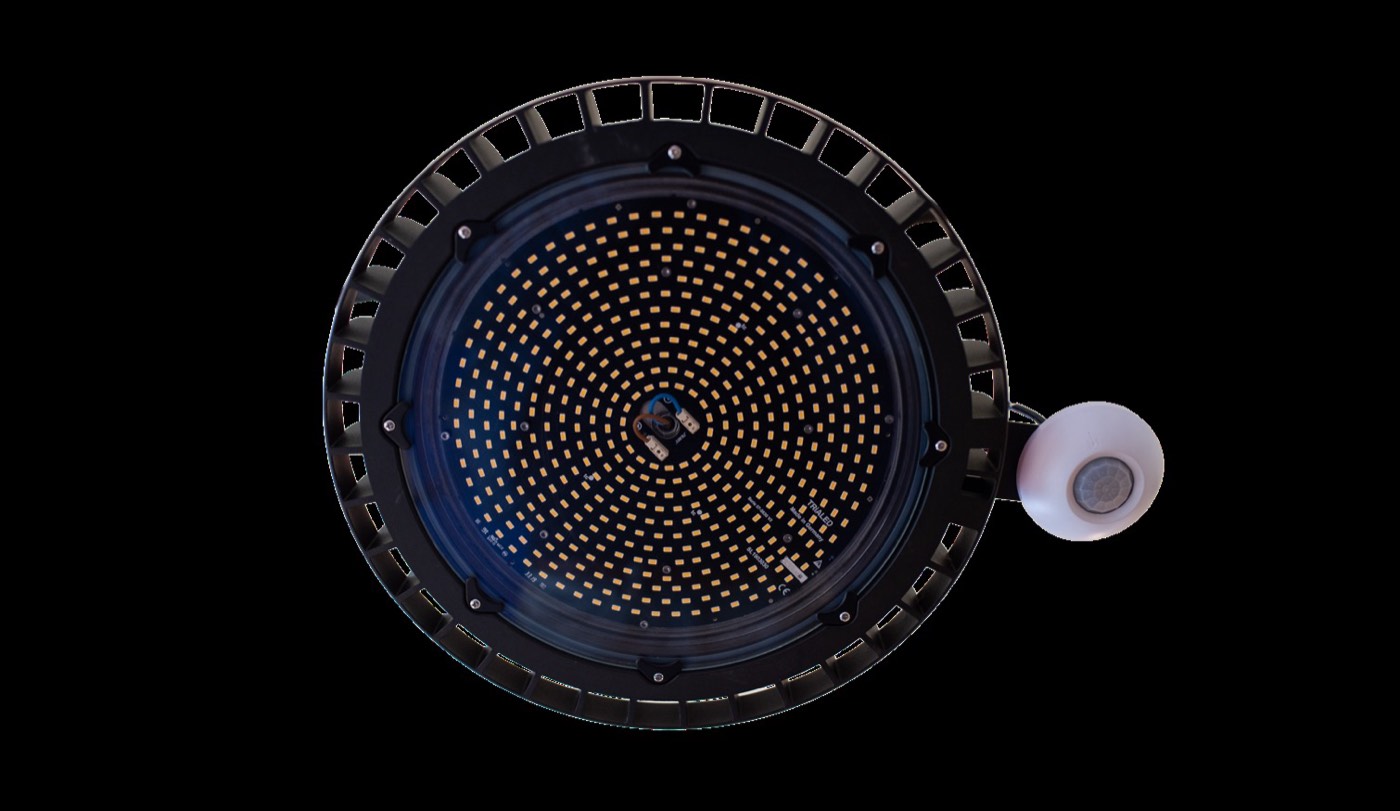
- Luminaires and sensors: LED luminaires from our own production with sensors from Autani and Keilton, networked via Bluetooth Mesh.
- Installation and commissioning: We install, wire and set up the controls – during operation and in stages.
- Analysis: The Autani Energy Manager makes operating hours and consumption available for analysis. We agree the connection to the building management system via BACnet/IP or Modbus TCP in the project.
What do controls add on top of LED?
100 LED luminaires of 100 W each, running 4,000 hours a year, use 40,000 kWh without controls.
If the controls save 30 % of that, that is 12,000 kWh – at €0.25 per kWh, around €3,000 a year in electricity costs.
At 20 % it would be €2,000, at 40 % €4,000 a year.
All values are assumptions. How much the controls save in your building depends on occupancy times, daylight and zoning – we calculate it for your property.
LED savings calculatorWhat can your lighting save?Energy costs, CO₂ and payback in just a few minutes.Frequently asked questions
What is the GModG?
The Building Modernisation Act (GModG) is the German law on the energy efficiency of buildings. It has applied since 29 July 2026, replaces the Building Energy Act (GEG) and transposes the EU buildings directive EPBD.
Is automatic lighting control mandatory under the GModG?
Yes, for non-residential buildings whose heating, air-conditioning or ventilation system has a rated output of more than 70 kW. Under § 56 para. 6, automatic lighting control must be installed by 31 December 2029 unless this is technically impossible or economically unreasonable.
Does the lighting count towards the 70 kW?
No. What counts is the rated output of the heating, air-conditioning or ventilation system. The lighting load is not included.
Does every luminaire need a sensor?
No. The law requires automatic lighting control that is to be appropriately zoned and have occupancy detection. How many sensors are needed and where they go is determined by the design.
Does the 290 kW threshold still apply?
No. The building automation duty under § 71a GEG applied from 290 kW. Since 29 July 2026, the GModG sets a single threshold of 70 kW with a deadline of 31 December 2029. 290 kW now only plays a role in the requirements for new buildings.
Who offers lighting control under the GModG?
TRiALED designs and delivers lighting and lighting control for non-residential buildings from a single source: lighting audit, lighting design, LED luminaires from our own production, sensors and light management from Autani and Keilton, installation and commissioning.